The recent UK general election was an overwhelming victory for the Conservative party. One electoral promise which has been emphasised by the incoming Conservative majority (asides from obviously delivering Brexit), was improving transportation for the North of England, in which it picked up a large number of seats. With this in mind, it’s time to draw attention to one northern city which needs to be highlighted, in its ongoing struggle to improve its transportation infrastructure.
If you’ve paid any attention to the news over the past few weeks or so, you may have noticed that an election has taken place. By now you’re probably aware of the general narrative. Labour party strongholds for generations have voted Conservative for the first time in decades. These places have been described as neglected, not listed to and even dismissed by a party that many voters feel have taken them for granted.
Now that the dust has settled, there is a certain expectation in the air. Many voters are now asking if Prime Minister Boris Johnson can fulfil his promises to the North. One promise made to the region was increased spending on its transportation. It has often been perceived that the North has lost out on much needed infrastructure spending, at the expense of London and the South East. However, there is one northern city in particular, where investment is definitely required.
The Situation in Leeds
Leeds is close to my heart, as I lived in the city for quite a while. Unfortunately, one overwhelming memory of Leeds, was being sat stationary in rush hour traffic. For a commute of roughly five miles, it wasn’t unusual for the journey to take more than an hour. When you spend this much time stuck in traffic, you begin to obviously contemplate what a sheer waste of time the commute is. Furthermore, surely there must be a solution to this problem? If anywhere is deserving of infrastructure spending to tackle this issue, it is definitely Leeds. In fact, Leeds has been proven to have some of the worst congestion in the entire United Kingdom.
Some readers may be calling me lazy at this point. Why not walk? Well five miles each way may be a little steep, (full credit to anyone who does this day in day out, by the way!). How about cycling? Again, I give my utter respect to anyone who bikes around Leeds. Despite, some effort to improve the situation for cyclists, the infrastructure for biking is far from adequate.
Okay, so why not take a bus? The problem is that a bus is often as slow at rush hour as a car, given that in the vast majority of places, buses have to share road space with private vehicles. This has reduced the quality of the service, with buses frequently being delayed. Consequently, this further dissuades people from using the service. Why take the bus if it offers no time benefit? This has led to passenger numbers actually falling in recent years. Thus it is clear that many residents perceive the car, as the only realistic option of transportation.
Now at this point, it is important to clarify, that Leeds is not completely isolated in terms of public transport. Leeds station is a vital part of the railway network and is a major hub connecting multiple north to south routes and east to west routes throughout the country. In fact, it is the third busiest station outside of London. However, the main problem is that there is no rapid transport system to allow people to move around the centre of Leeds. In fact, this has left Leeds with the unenviable title, of being the largest city in Western Europe without a rapid transport system. More than 800,000 residents lack the necessary infrastructure to move conveniently and efficiently around the city. Hence it is easy to understand why voters are tired of the status quo and are demanding urgent action, given such a clear lack of investment in their area.
To demonstrate how bad Leeds public transport really is, the following process was implemented. A radius of 3 miles from Leeds station has been drawn, (as is shown below).
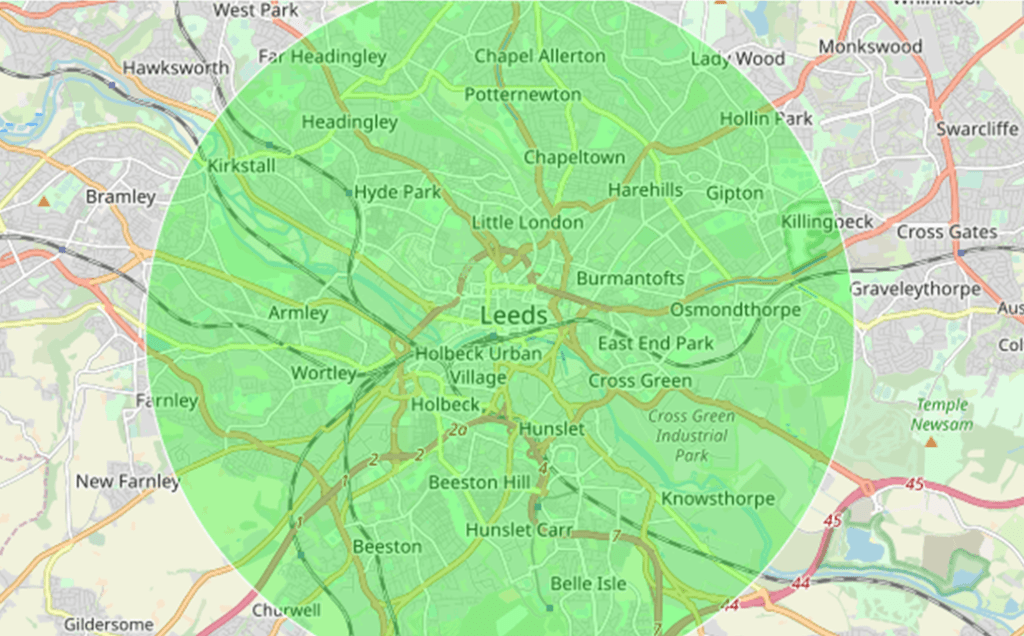
(Source: Free Map Tools)
The number of other rapid transport stations (this includes train, metro or tram stations) within a 3-mile radius of the main city station were then counted. This process was then repeated for a range of core northern cities including Liverpool, Sheffield and Newcastle. For Leeds there are just 3 other stations within the 3-mile radius…. Just to clarify that’s not a typo. Compare this with Sheffield, where there are numerous tram stations within a 3-mile radius of the main station. Leeds comes out just as badly when compared against Newcastle and Liverpool, which have numerous metro stations within the same 3-mile radius.
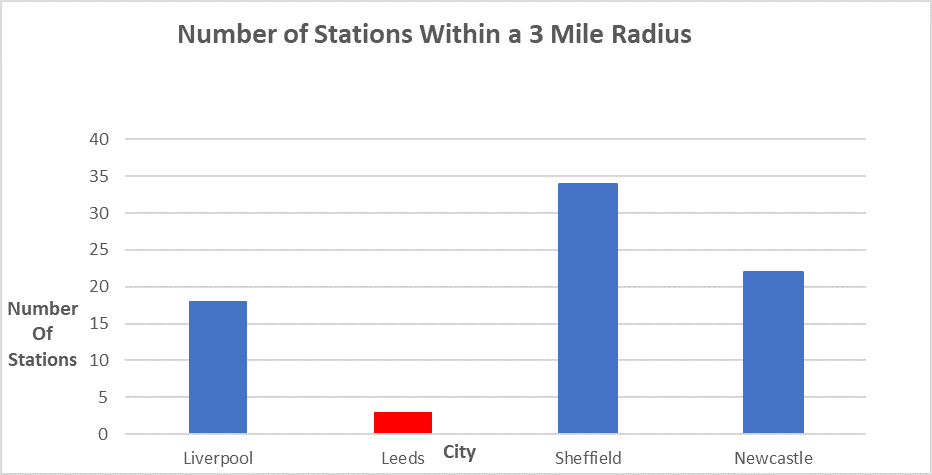
Consequently, it is glaringly obvious to see that Leeds is at a clear disadvantage when it comes to providing adequate transportation for its residents. Voters in this part of the country have waited far too long for improvements. In the 2019 election, much of the traditional labour majority in many constituencies across Leeds, was heavily reduced. Furthermore, seats in the wider Leeds metropolitan area, including Dewsbury and Wakefield, were actually lost to the Conservative party. These voters now expect progress on many issues and transport in this area is a major priority.
How did the city get into its current situation?
Before talking about potential projects to improve the situation, it is important to ask, how did things get this bad? Surely there must have been ideas on how to fix the problem? Well, as with many cities across the UK, Leeds got rid of its tram network in favour of infrastructure more suited to the motorist. This was an ambitious plan to become the city of the future, more specifically: a motorway city. Nowadays this seems a little bit laughable, but at the time it was quite a revolutionary and futuristic plan for Leeds. However, is important to recognize that this plan had some very real consequences. For example, the M621 motorway which exists today, formed part of an overall plan to allow cars easy access to and around Leeds. Unfortunately, when you drive on the M621, it becomes quite apparent how it has bulldozed its way through South Leeds. Many of these areas have been split by the motorway. Getting from one side to the other is extremely challenging, as there are very few bridges crossing the motorway. Hence, walking around the area is made very difficult. There is also an extremely limited bus service and as has already been mentioned and an almost non-existent train service. This has had a severe negative impact upon these areas, which are amongst the most deprived in the entire country. With the city being designed for cars, the availability and promotion of public transport has clearly suffered and for many residents, a car is an absolute necessity.
Potential Improvements
So, what are the current plans to improve the situation? There is a plan to improve transport links on the existing main railway line between Leeds and Manchester. Doubling existing track on the railway between Leeds and Huddersfield and electrifying parts of the line, is welcome news. Many people commute around the West Yorkshire metropolitan area, so providing more frequent and reliable services between these areas, is a good start. This should encourage people towards using the train and away from their cars. However, these improvements have been proposed before and have been delayed before. Indeed, the current plans do not meet the original larger scale plans for this key rail artery. Fulfilling the current plans, really is a bare minimum requirement. Additionally, the plans suggest that it could be well into the mid-2020s before this work is completed. Furthermore, this particular plan does not adequately address the need for transportation within Leeds.
So, what else can be done to solve Leeds’s very specific problem? Well as has already been stated, Leeds is an important railway interchange, with a large number of lines converging into Leeds. An obvious solution would therefore be to build more inner-city stations on these existing lines into the city. However many of these lines are already congested, including the increasingly busy Manchester-Leeds route. Furthermore, capacity at Leeds station is already stretched and consequently any small issues on the network can escalate extremely quickly. Hence adding more local stations and services around inner Leeds on the current infrastructure would be a gigantic challenge.
One potential solution to the capacity issues could lie in the form of HS2. As well as providing rapid journeys to London and Birmingham, HS2 would add a 2nd station and alleviate some of the pressure on the current Leeds station. However, this at the very earliest is going to take well over a decade to arrive. Leeds needs action now, not by the 2030’s. Additionally, the ability to improve local services as a result of capacity freed by HS2 is debatable. This is because HS2 would only accommodate particular intercity journeys. Unfortunately, most of the journeys currently in and out of Leeds station would not be served by HS2. Additionally, further funding to build new stations on freed up routes and lots of other investment, would be necessary in order to take full advantage of HS2.
The Need for a Tram
At this point, the options for Leeds seems a tad depressing. However, it is important to remember that in recent decades, many other UK cities, have built new tram networks. In many cities these networks are growing, with consumers using these networks instead of private vehicles. It is also important to recognise that there were plans to deliver a new tram network for Leeds in the 21st century. After all this is not a new proposal. Unfortunately, the Labour party did not do itself any favours, when it cancelled the money for a tram network in the city back in 2005, citing a lack of funding. Alternative suggestions have been discussed, delayed and then scrapped. One notable suggestion was a trolleybus network. However, this was perceived to have no significant benefits given the overall cost and was subsequently cancelled. Since this project, there has been no prominent solutions put forward to properly address transportation, within Leeds.
As stated, residents desperately need a way to move efficiently around its inner-city areas. Building a tram network would facilitate this obvious demand. The system would also be environmentally beneficial and be a key component, in leading the fight against air pollution within Leeds. Furthermore, the tram system could run separately in most areas from private vehicles and thus avoid congestion and run a quick, frequent and efficient service. This would further incentivise residents to get out of their cars and use the tram network. This is not just some speculative fantasy either. Many UK cities which have built tram systems have seen a dramatic shift in their transport use from car to trams. The use of a parking levy in Nottingham, also provides an example of how cities can raise money in order to pay for such systems, without the need to rely solely upon government funding.
With a lack of action over many decades, the problems of congestion, air pollution and general mobility issues remain. This problem is not going to resolve itself any time soon. Leeds and its wider metropolitan areas are growing rapidly. There is clearly a demand to get to around the city centre and to and from Leeds station. 30 million journeys are taken by taxi within Leeds each year. This firstly demonstrates that there is a huge demand for transportation around Leeds. Furthermore, this data also illustrates that a third of all taxi journeys either started or ended at Leeds station. This equates to 10 million journeys, purely arising from people wanting to get to and from Leeds station! Consequently, this proves that the demand for a rapid transport system within Leeds is clearly there. Furthermore, this demand will not slow any time soon, with Leeds constantly developing and expanding. By 2033 it is predicted that Leeds’s population will be nearing 1,000,000 residents. If improvements are not made now, infrastructure which is already struggling at the present, will not be able to cope with further pressure. Moreover, if other smaller cities within the UK can build a rapid transport system, there is no reason why with the right drive and ambition, that Leeds cannot have a tram network of its own.
With no real alternative to private vehicle usage, Leeds’s strained road system will continue to be tested. Boris Johnson may have won the 2019 election, now he will have to deliver on his promises to these new Conservative voters. The city and its wider metropolitan area are definitely in need of dramatic improvement to transportation and the voters are waiting. If these improvements are not made, voters in the area may not be willing to give the Prime Minister a second chance. Leeds has waited far too long for proper investment, it shouldn’t have to wait any longer for a rapid transport system, which a city of its scale absolutely needs.
 Transportation Contemplation